2024

Tips and Tricks for Managing Stones in the Complex Patient

Colin E. Kleinguetl, MD, presents guidance and strategies for kidney stone management in chronically infected and pregnant patients. He begins by discussing challenges to managing kidney stones in the pregnant patient, including:

The weaknesses of kidney stone imaging options
The pros and cons of radiation during diagnosis
The importance of working with the patient’s OBGYN during treatment
The treatment options available to pregnant kidney stone patients

Dr. Kleinguetl concludes by turning to patients with chronic UTIs, acknowledging the circular relationship between recurrent/persistent UTI and kidney stone disease. He then addresses common causes of stones in chronically infected patients and effective treatment options depending on the cause of the infection.

Read More

Gleason 6 (GG1) – Should It Be Called Prostate Cancer?

Jeremy Slawin, MD, MBA, presents arguments for and against the reclassification of Gleason 6 (GG1) as something other than prostate cancer. He begins with a brief overview of the definition and perception of prostate cancer, and the psychological burdens and implications which come with cancer diagnoses.

Dr. Slawin then addresses the growing momentum in favor of a change in nomenclature for Gleason 6 (GG1) that does not include the word “cancer,” as has been done for diseases like noninvasive follicular thyroid neoplasm with papillary-like features (NIFTP), formerly called papillary thyroid cancer. Dr. Slawin presents data supporting the idea that GG1 is closer to pre-cancer in clinical behavior, detection, and management, and that calling it a cancer may drive overtreatment of GG1.

Dr. Slawin then turns to arguments against the reclassification of GG1. He addresses the issue of undersampling in biopsies which lead to GG1 diagnoses, the risk of under-grading, and how failing to call GG1 “cancer” could give a false perception of risk and lower the already-low patient compliance rates in active surveillance treatment.

Dr. Slawin concludes by giving his perspective on the issue of changing the nomenclature for GG1. He, along with most pathologists, is not in favor of reclassifying GG1, and leads a Q&A with the audience to gather their perspectives.

Read More

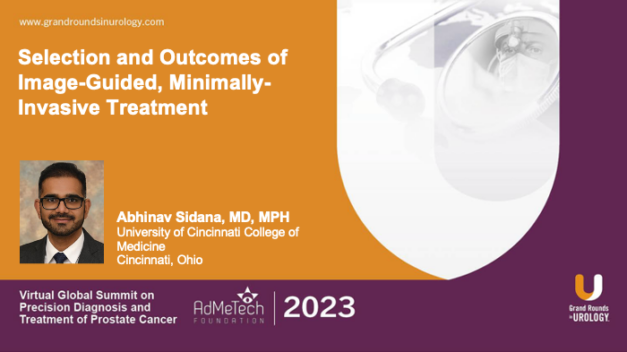
Selection and Outcomes of Image-Guided, Minimally-Invasive Treatment

Abhinav Sidana, MD, MPH, aims to identify key selection criteria for image guided minimally invasive treatments, also known as focal therapy, for prostate cancer. Dr. Sidana begins by noting that the use of focal therapy for prostate cancer treatment has become widespread in the past decade.

Dr. Sidana then addresses current EAU and NCCN guidelines for focal therapy. He highlights the lack of guidelines specific to focal therapy, and notes that the medical community has been trying to address this deficiency in recent years.

Dr. Sidana concludes by summarizing current best-practices regarding appropriate imaging modalities for screening, appropriate biopsy strategies, and optimal characteristics for determining focal therapy candidacy. He highlights the importance of the correct selection of energy modality in treating prostate cancer, noting that not every surgeon will have access to all the available energy modalities.

Read More

Long-Term Care of the Neurogenic Bladder

R. Caleb Kovell, MD, discusses effective treatments for complex neurogenic bladder patients, including early and long-term interventions. He presents several factors physicians should take into account when treating challenging neurogenic bladder patients, including:

Male and Female Sexual Health Issues
Bladder Stones
Urinary Continence
Previous Augmentation Cystoplasty
Previous Diagnosis of Spina Bifida

Read More

PCa Commentary | Volume 186 – February 2024

Active surveillance is the preferred strategy for low- and favorable intermediate-risk prostate cancer, preserving quality of life while maintaining excellent long-term cancer control. Genomic classifiers and emerging AI-driven models refine patient selection and provide dynamic, individualized risk prediction for Gleason grade progression.

Read More