


Michael Hofman MBBS, FRACP, FAANMS, FICIS, GAICD

Michael Hofman MBBS, FRACP, FAANMS, FICIS, GAICD

The University of Melbourne

Melbourne, Australia

Professor Michael Hofman, a Nuclear Medicine Physician, leads the Prostate Cancer Theranostics and Imaging Centre of Excellence (ProsTIC) at the University of Melbourne's Peter MacCallum Cancer Centre. His groundbreaking research in PSMA PET and PSMA radioligand therapy has revolutionized prostate cancer imaging and treatment, resulting in FDA approval, Australian MBS funding, and a $2.1 billion investment by Novartis.

Hofman's passion for novel radiopharmaceuticals drives him to collaborate globally on Phase I, II, and III clinical trials, addressing unmet needs in oncology. As a key member of the Australasian Radiopharmaceutical Trials Network's scientific committee, he helped create a 10+ centre network across Australia, producing two landmark clinical trials published in The Lancet.

Talks by Michael Hofman MBBS, FRACP, FAANMS, FICIS, GAICD

Molecular Imaging

Professor Michael Hofman presents advances in PSMA PET imaging for prostate cancer, highlighting results from the ProPSMA and PRIMARY trials. He discusses diagnostic accuracy, integration with MRI, standardization efforts, and the role of artificial intelligence in improving interpretation and reducing unnecessary biopsies.

Read More
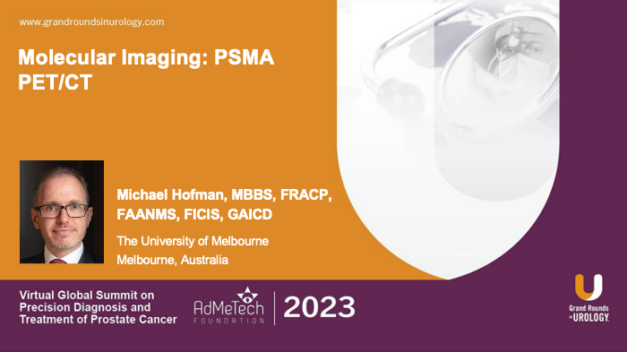
Molecular Imaging: PSMA PET/CT

Michael Hofman, MBBS, FRACP, FAANMS, FICIS, GAICD, compares the effectiveness of PSMA PET with CT against the standard CT and bone scan. He begins by briefly reviewing findings from the ProPSMA study, which indicated that PSMA PET/CT had greater accuracy in identifying prostate cancer than a standard CT plus bone scan, or “conventional imaging.”

Dr. Hofman discusses the adoption of PSMA PET/CT as a standard of care in different international medical guidelines. He notes that some medical communities have embraced PSMA PET/CT as a replacement for conventional imaging in patients who meet the appropriate criteria for PSMA PET/CT, while others have only adopted it as a supplement to conventional imaging.

Dr. Hofman argues against a common argument for keeping conventional imaging scans as part of standard care, the issue of stage migration. Dr. Hofman argues that, while PSMA PET/CT is a more sensitive test, it also has greater specificity and yields fewer false-positives than conventional imaging. He supports this point by evaluating several equivocal studies comparing PSMA PET/CT and CT/bone scans in patients with various metastatic burdens.

Dr. Hofman concludes with a brief discussion on the lower financial burden of PSMA PET/CT, and on the future directions of PSMA PET/CT in detecting quantitative total tumor volume. He acknowledges the lack of standardization in PSMA PET/CT reporting and encourages fellow clinicians and academics to participate in the creation of standard reporting practices for PSMA PET/CT.

Read More