How to cite: Streeper NM. Individualized Dietary Therapy for Kidney Stone Prevention: Practical Dietary Approaches. Grand Rounds in Urology. February 2026. Accessed Oct 2026. https://grandroundsinurology.com/individualized-dietary-therapy-for-kidney-stone-prevention-practical-dietary-approaches/
Summary
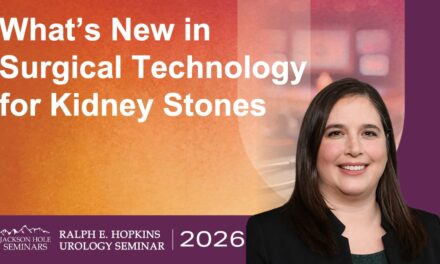
Necole M. Streeper, MD, Associate Professor of Urology, Medical College of Wisconsin, Madison, Wisconsin, contrasts empiric dietary counseling with individualized medical nutrition therapy for stone prevention, arguing that selective therapy based on metabolic evaluation, stone risk factors, comorbidities, and follow-up is preferable to providing uniform recommendations to all patients. Dr. Streeper emphasizes that patients are more likely to follow 1 to 3 prioritized recommendations than broad restrictive regimens.
Fluid intake is the primary recommendation for nearly all stone formers, with a goal of urine output above 2.5 liters per day, supported by approximately 3 liters of daily fluid intake. Dr. Streeper reviews dietary management approaches for hypercalciuria, hyperoxaluria, hypocitraturia, hyperuricosuria, low urine pH, and low urine magnesium. Rather than broad elimination strategies, she emphasizes maintaining normal dietary calcium intake, reducing excess sodium and acid load, prioritizing calcium with meals for hyperoxaluria, encouraging fruit and vegetable intake, and considering practical sources of dietary alkali.
She stresses avoiding unnecessary dietary restrictions. Dr. Streeper advises against routine low-oxalate diets as first-line therapy and instead promotes moderation, food substitutions, and preservation of overall nutritional quality. She reviews counseling strategies to improve adherence, including simplifying recommendations, identifying barriers, showing evidence of effect through urine testing or imaging, and addressing conflicting dietary messages patients receive.
Dr. Streeper highlights that individualized dietary therapy is most effective when recommendations are selective, practical, prioritized, and designed to support long-term adherence rather than short-term restriction. Increasing fluid intake, focusing on 1 to 3 recommendations, and emphasizing the addition of beneficial foods are central principles of prevention.
About the 45th Annual Ralph E. Hopkins Urology Seminar
The Annual Ralph E. Hopkins Urology Seminar, also known as the Jackson Hole Seminars, brings together distinguished urologists, clinical researchers, and thought leaders to share wisdom and experience that drives meaningful progress in patient care. Changes occur in medicine and urology on an almost daily basis, so it is imperative that the practicing urologist remains on the cutting edge. Urologists need to keep current on assessing, diagnosing, and treating urologic conditions in the clinical setting. The 45th meeting took place in 2026, focusing on urologic cancers, stone disease, urologic reconstruction, female urology, infertility, emerging surgical techniques, and general urology. 2026 also marked the meeting’s first-ever all-female speaker panel.
ABOUT THE AUTHOR
Necole M. Streeper, MD, is an Associate Professor of Urology at the Medical College of Wisconsin, Madison, Wisconsin. She specializes in surgically treating complex kidney stone disease and the prevention of kidney stones.
Dr. Streeper earned her medical degree from the University of Iowa. After a residency in Urology at the University of Texas Health Science Center, she completed a fellowship in Endourology and Minimally Invasive Surgery at the University of Wisconsin-Madison.
Dr. Streeper’s clinical research is dedicated to improving the prevention and treatment of kidney stones, and she is interested in identifying management strategies to improve the quality of life in patients with kidney stones. She has received NIH/NIDDK grant support to develop technology (SipIT) to improve fluid consumption for the prevention of kidney stones. Dr. Streeper is the lead investigator for MCW as a research site in the North American Stone Quality of Life Consortium, and has authored more than 50 research publications and book chapters in the field of kidney stone disease.