Sequencing Lu-177 PSMA-directed RLT
This expert panel, led by Dr. Michael Morris, with Drs. Jérémie Calais and Neal Shore, explores how Lu-177–PSMA therapy is moving earlier in prostate cancer care.
Read More


This expert panel, led by Dr. Michael Morris, with Drs. Jérémie Calais and Neal Shore, explores how Lu-177–PSMA therapy is moving earlier in prostate cancer care.
Read More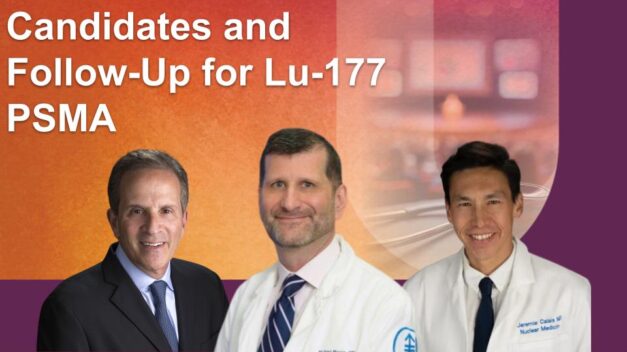
An expert panel reviews imaging criteria, candidate selection, and follow-up strategies for Lu-177 PSMA therapy, comparing VISION and TheraP trial frameworks.
Read More
Mark N. Painter, CPMA, MBS, Managing Partner, Consulting LLC, CEO, PRS Urology Service Corporation, Vice President of Coding and Reimbursement Information and CEO Relative Value Studies, Inc. is joined by Neal D. Shore, MD, FACS and David S. Morris, MD, FACS to discuss the physician’s perspective on the upcoming Medicare Part D updates. They share the benefits of these changes and the possible hardships as well.
In this third part of this series, Mark briefly highlights the Medicare Part D changes, such as the reduction of the maximum out-of-pocket expenditure and the Medicare Prescription Payment Plan (MPPP) or “smoothing option”, that the first part of this series covers in more detail. Neal D. Shore, MD, FACS and David S. Morris, MD, FACS then join Mark to share their point of view as physicians on how they are planning to maneuver these changes in the best way. David S. Morris, MD, FACS discusses how he thinks these changes will give a positive outlook to a patient’s finances, for example with the smoothing option or through grants. Also, Neal D. Shore, MD, FACS shares how offices have to prepare to help patients through the process of understanding and taking advantage of these upcoming updates.
This 15-minute discussion concludes with all speakers agreeing that the financial burden on the patient is key when it comes to medications, but they are cautiously optimistic that these upcoming changes will benefit patients, although many will still rely heavily on grants and funding to get the medications they need. Both physicians share in their hope that the upcoming Medicare Part D changes will be a step in the right direction to making healthcare more accessible to all patients and a reminder: Open Enrollment begins October 15, 2024, and runs through December 7, 2024.
Read More
In a program supported by Verity Pharmaceuticals, Neal D. Shore, MD, FACS, Medical Director for the Carolina Urologic Research Center and Chief Medical Officer, Strategic Growth and Pharmacy, GenesisCare US, Myrtle Beach, South Carolina, and Laurence Klotz, MD, FRCSC, Professor of Surgery at the University of Toronto and the Sunnybrook Chair of Prostate Cancer Research in Toronto, Ontario, Canada, discuss Dr. Klotz’s paper published in January 2024 entitled, “Testosterone Nadir and Clinical Outcomes in Patients with Advanced Prostate Cancer: Post Hoc Analysis of Triptorelin Pamoate Phase III Studies.”
Dr. Klotz describes the objective of the study was to evaluate whether low nadir testosterone during treatment with triptorelin pamoate, a luteinizing hormone-releasing hormone (LHRH) agonist, is associated with improved clinical outcomes in patients with advanced prostate cancer using a retrospective analysis of clinical trial data. He discusses how data was pooled from three prospective, 9–12-month Phase III studies of triptorelin monotherapy in patients with advanced prostate cancer
Dr. Klotz also addresses the overall survival (OS) and disease-specific survival (DSS) by testosterone suppression group, assessed by Kaplan–Meier analysis with a log-rank test. He concludes the review by describing how, in the sample size comprised of 592 patients, low nadir testosterone achieved during treatment with the LHRH agonist triptorelin was associated with improved OS and DSS in patients with advanced prostate cancer.
Dr. Klotz and Dr. Shore then discuss the impact of the results from this trial and the potential future direction of treatment options for men with prostate cancer.
Read More
In this presentation, supported by Telix Pharmaceuticals, Neal D. Shore, MD, FACS, Medical Director for the Carolina Urologic Research Center in Myrtle Beach, South Carolina, presents advances in PSMA PET-CT imaging for staging, prognosis, and clinical management of prostate cancer. He first describes prostate cancer metastases before explaining prostate-specific membrane antigen (PMSA) and how it serves as an effective molecular target for metastatic prostate cancer. Dr. Shore reviews the pros and cons of conventional imaging techniques such as bone scintigraphy, computed tomography (CT), and multiparametric MRI (mpMRI). While treatment guidelines recommend conventional imaging, he notes that bone scans and CT positively identify less than 10% of men with biochemical recurrence and in particular lesions that are <1 cm with a PSA <20 ng/mL. He then compares the benefits of PSMA as an imaging target: it is upregulated in prostate cancer, the degree of expression is positively correlated with tumor state and higher risk of recurrence, there is a positive correlation between PSMA expression and Gleason score/grade, and it may be targeted with either a small molecule or antibody. Dr. Shore reviews numerous studies demonstrating the effectiveness of PSMA PET-CT in metastatic prostate cancer but indicates there is insufficient data on the use of PSMA PET-CT in patients with hormone-naïve disease. He then considers patient selection and points out several downsides including increased cost of care and the potential impact of health disparities. He concludes that PSMA PET-CT is particularly useful in detecting prostate cancer that is otherwise not identified by conventional imaging and in cases with low serum PSA.
Read More