
Sigrid V. Carlsson, MD, PhD, MPH

Sigrid V. Carlsson, MD, PhD, MPH

DKFZ German Cancer Research Center

Heidelberg, Germany

Sigrid V. Carlsson, MD, PhD, MPH, is the Division Head of the Clinical Epidemiology of Early Cancer Detection at DKFZ German Cancer Research Center in Heidelberg, Germany. Her research focuses on developing risk-stratified approaches to screening, diagnosis, treatment, and follow-up. 

Dr. Carlsson earned her MD and PhD from Gothenburg University in Sweden. She earned an MPH from Harvard in Boston, Massachusetts. Dr. Carlsson has been funded by the Prevent Cancer Foundation to develop a decision support tool for prostate cancer screening. She holds a career development award from the National Institutes of Health/National Cancer Institute, mentored by Drs. Jennifer Hay and Jada Hamilton, to optimize the practical application of shared decision-making and implementing risk-stratified approaches to screening and follow-up in oncology.

Dr. Carlsson serves on the National Comprehensive Cancer Network (NCCN) and is a panel member for the American Urological Association (AUA) guidelines for early detection of prostate cancer. She has authored and co-authored over 300 publications and has been featured in Société Internationale d’Urologie Journal, The Journal of Urology, European Urology, Clinical Chemistry, Urologic Oncology Seminars and Original Investigations, and more.

Talks by Sigrid V. Carlsson, MD, PhD, MPH

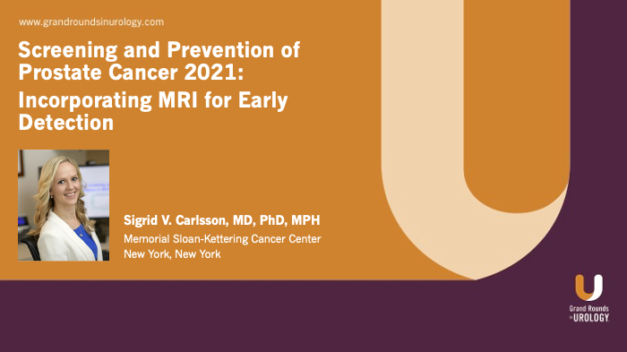
Screening and Prevention of Prostate Cancer 2021 (Part 3): Incorporating MRI for Early Detection

In the final part of a 3-part series, Sigrid V. Carlsson, MD, PhD, MPH, Assistant Attending Epidemiologist at Memorial Sloan Kettering Cancer Center, considers the current role of MRI in early detection of prostate cancer. She explains that while MRI is a useful screening tool, it is not foolproof, and its accuracy varies widely depending on user expertise. For this reason, using a negative MRI to justify not getting a biopsy is not always strongly advised. However, many studies are underway that may identify combinations of MRI and biomarker tests that will ultimately help patients avoid more unnecessary biopsies.

Read More
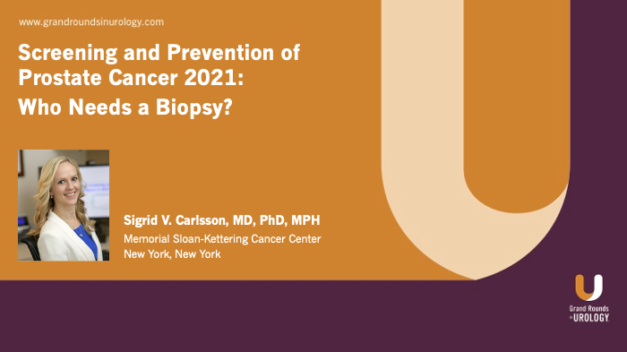
Screening and Prevention of Prostate Cancer 2021 (Part 2): Who Needs a Biopsy?

In part 2 of a 3-part series, Sigrid V. Carlsson, MD, PhD, MPH, Assistant Attending Epidemiologist at Memorial Sloan Kettering Cancer Center, goes over her 5 Golden Rules for prostate cancer testing, which are intended to minimize overdiagnosis and overtreatment while also making sure that significant disease is not missed. Rule 1 is to get consent and engage in shared decision-making with patients. Dr. Carlsson notes that this can sometimes be difficult since the numerous decision aids available are often difficult to use and understand. The second rule is not to screen men who will not benefit, for instance, older men with multiple comorbidities and short life expectancies. Dr. Carlsson does observe, however, that instituting an age cutoff does not necessarily make sense, and that physiologic assessment of life expectancy may be a more useful metric. In rule 3, Dr. Carlsson advises clinicians not to biopsy patients without a compelling reason, since prostate biopsies may lead to infectious complications and hospitalization. She then lays out the options for risk stratification, such as risk calculators, biomarker tests, and MRI. Rule 4 recommends against treating low-risk disease since, as Dr. Carlsson explains, active surveillance is a safe strategy over longer follow-up for appropriately selected patients with Grade Group 1 prostate cancer when following a well-defined monitoring plan. Finally, rule 5 exhorts clinicians to send patients who require treatment to a high-volume provider. This is key, Dr. Carlsson argues, since evidence shows that there is a large degree of heterogeneity among surgeons regarding functional and oncological outcomes after prostatectomy, and it takes approximately 250 surgeries for a surgeon to really master the procedure.

Read More

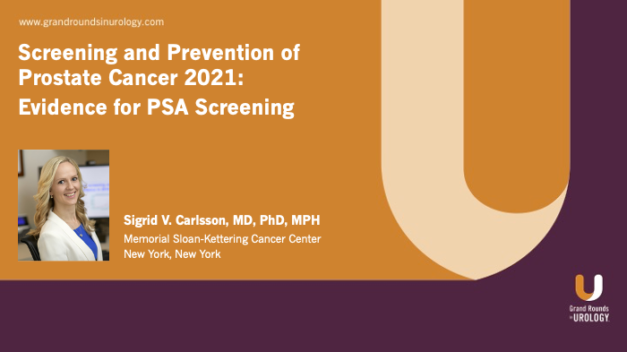
Screening and Prevention of Prostate Cancer 2021 (Part 1): Evidence for PSA Screening

In part 1 of a 3-part series, Sigrid V. Carlsson, MD, PhD, MPH, Assistant Attending Epidemiologist at Memorial Sloan Kettering Cancer Center, looks at the evidence supporting widespread prostate specific antigen (PSA) screening. She looks at a range of large studies with long follow-up that demonstrate a reduction in prostate cancer mortality of approximately 30% as a result of widespread PSA screening. Dr. Carlsson also looks at how PSA screening decisions can be made by taking other risk factors into account in order to minimize unnecessary testing. She also notes that the loss in quality-adjusted life years somewhat offsets the benefits of widespread screening. She concludes by introducing her 5 Golden Rules of testing to keep the benefits and reduce the harms.

Read More

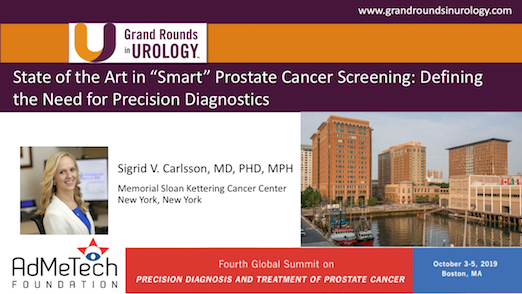
State of the Art in “Smart” Prostate Cancer Screening: Defining the Need for Precision Diagnostics

Sigrid V. Carlsson, MD, PhD, MPH, discusses the evolution of attitudes toward PSA screening for prostate cancer over time, and the importance of implementing the PSA test in a way that will truly benefit patients. She details how risk-stratifying algorithms and calculators, biomarkers, and MRI can play a role in refining prostate cancer screening.

Read More