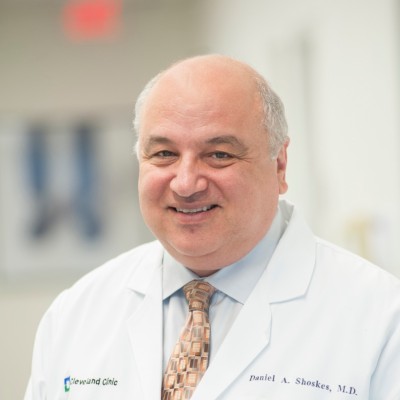
Daniel Shoskes, MD, MSc, FRCSC

Daniel Shoskes, MD, MSc, FRCSC

Case Western Reserve University

Cleveland, Ohio

Daniel A. Shoskes, MD, MSc, FRCS(C), is the Vice President, Global Medical Director of Uro-Oncology at Ferring Pharmaceuticals in Cleveland, Ohio. Dr. Shoskes also serves as Professor Emeritus of Urology at Case Western Reserve University in Cleveland, Ohio. Dr. Shoskes' clinical interests include renal transplantation, chronic prostatitis, chronic pelvic pain syndrome, interstitial cystitis and benign prostatic hypertrophy. Dr. Shoskes’ areas of speciality in Medical Affairs include development of Investigator Initiated Trials Programs, commercial launch of new diagnostic tests in Urologic Oncology, leadership of multifunctional teams, collaboration with Marketing and Sales, training of sales staff and medical science liaisons, development of medical slide decks, and clinical trial design.

Dr. Shoskes earned his medical degree from the University of Toronto in Canada. He completed an internship in Surgery from the Wellesley Hospital in Toronto. Dr. Shoskes then completed a residency in Urology at the University of Toronto. He then completed a research fellowship in Experimental Surgery at the University of Alberta in Edmonton, Alberta, Canada. Afterwhich, Dr. Shoskes completed a residency in Urology at the University of Toronto. He continued with a research fellowship in the Nuffield Department of Surgery at Oxford University in England. Dr. Shoskes then completed a fellowship in Renal Transplantation and Renovascular Surgery at The Cleveland Clinic in Cleveland, Ohio.

Dr. Shoskes has published 138 articles, 119 book chapters and reviews, and has served as book editor for 9 publications. He has presented nationally and internationally over 130 times, has been invited as a guest lecturer 58 times, and has moderated 25 scientific meetings. Dr. Shoskes has received numerous awards for his contribution in the field, including the Best Poster Presentation at the European Urological Association Meeting, Cleveland Clinic Innovator Award, and the Resident Education and Life-Long Learner (REALL) Resident Development Award. He has been awarded over $3 million in research funds including NIH, clinical, and translational projects.

Talks by Daniel Shoskes, MD, MSc, FRCSC

Industry Perspective: AR-V7 Testing for Men with Advanced Stage Prostate Cancer

Daniel Shoskes, MD, FRCSC, Medical Director in Medical Affairs for Urologic Oncology at Exact Sciences, and Emeritus Professor of Urology at the Cleveland Clinic, discusses AR-V7 testing for men with metastatic castrate-resistant prostate cancer (mCRPC). He begins by noting that mCRPC cannot be cured, but patients with mCRPC often benefit from multiple lines of sequential therapy. Dr. Shoskes explains that when one therapy fails, choosing the next therapy can often be difficult, in part because patients often prefer AR-targeted therapy over taxanes due to the less burdensome side effect profile of AR-targeted therapies. As a result, even though secondary AR-targeted therapy is only effective 22-46% of the time, AR-targeted therapies are administered back-to-back up to 60% of the time. Dr. Shoskes observes that AR variants are a common cause of AR-targeted therapy resistance, and of those variants, AR-V7 is one of the most common and best understood. He defines AR-V7 as a splice variant of the androgen receptor protein which is active without the ligand binding domain, making it resistant to abiraterone, enzalutamide, and apalutamide. Dr. Shoskes then introduces the Oncotype DX AR-V7 Nucleus Detect assay, which he argues can help clinicians quickly direct their mCRPC patients toward the right treatment. He explains that the Nucleus Detect assay detects the AR-V7 protein in the nucleus of circulating tumor cells, is predictive of resistance to AR-targeted therapies, provides easy-to-interpret and actionable results, and only requires a simple blood draw. Dr. Shoskes highlights that the Nucleus Detect assay has been validated in three independent studies, all of which found that it to be predictive of non-response to AR-targeted therapy. He concludes by discussing outcomes, noting that in the validation studies, AR-V7+ patients experienced a 76% survival benefit from being placed on taxane therapy versus AR-targeted therapy.

Read More

Industry Perspective: The Oncotype DX Genomic Prostate Score Assay Test

Daniel Shoskes, MD, FRCSC, Medical Director in Medical Affairs for Urologic Oncology at Exact Sciences, and Emeritus Professor of Urology at the Cleveland Clinic, explains how Exact Science’s Oncotype DX Genomic Prostate Score (GPS) assay test works, and considers its utility in guiding treatment decisions. He begins by discussing why genomics are of interest in relation to prostate cancer, highlighting the fact that abnormal gene expression may lead to abnormal/unregulated cell growth, which in turn may lead to irregularity on direct palpation, altered appearance on MRI, elevated PSA, and disordered gland appearance on histology. The researchers at Exact Sciences, Dr. Shoskes explains, hypothesized that these clinical features might not completely capture the prognosis of the patient, and that looking at gene expression directly might give further information. He relates how the researchers selected genes for association with metastasis and then refined the list for associations with death and adverse pathology. They found 17 genes that predicted recurrence in both the primary and highest Gleason patterns, and also had consistent analytical performance and expression in samples as small as 1mm. Dr. Shoskes then discusses how predictive this 17-gene assay is, noting that the GPS assay is an independent predictor of metastasis and prostate cancer death within 10 years of radical prostatectomy and may be associated with prostate cancer outcomes for up to 20 years after diagnosis. He highlights that incorporating the GPS result with NCCN Guidelines can provide a comprehensive risk profile. Dr. Shoskes considers how the GPS assay can be used practically, explaining that for low-risk patients, it can help inform shared decision-making for active surveillance vs. immediate therapy with curative intent, while for higher-risk patients, it can help inform the decision for treatment intensification. He concludes that the Oncotype DX GPS assay provides meaningful, actionable information on the biologic potential of prostate cancer independent of clinical, pathologic, and radiographic data.

Read More